
Management plan · Use case 4 of 8
Roadside ditch and swale maintenance standards
Field standards that keep ditch cleanouts from feeding the problem they're meant to fix.
Charlotte County, Florida · GRASS: Guidelines for Roadside And Swale Stewardship
The project
The problem
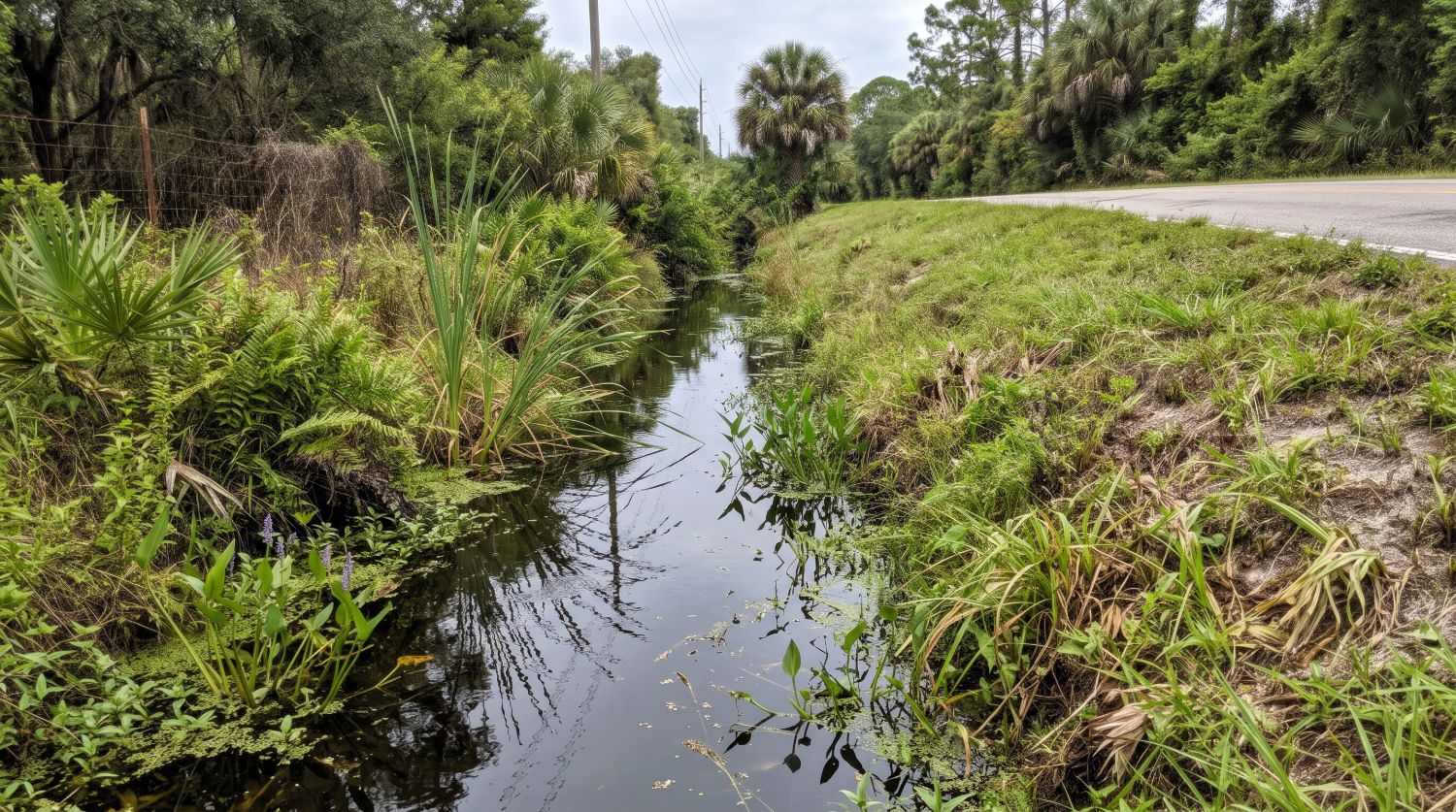
A common cleanout drives an excavator down the ditch and leaves torn-out plants in the channel. They rot, release nutrients and use up oxygen, and bare banks erode until the next cleanout.
What sets it apart
Every standard traces to a source: NRCS handbooks, Florida law, FWC rules, EPA guidance and UF research, written as contract language and an inspection checklist crews can use.
- Where
- Charlotte County, Florida
- Scale
- 3 drainage types, 5 maintenance levels, 15 sections of field standards
- What we provided
- A vegetation management plan with contract language and an inspection checklist
Who helped shape this concept
-
 UF/IFAS University research the standards draw on
- Federal and state agency standards USDA Natural Resources Conservation Service (NRCS) handbooks, EPA guidance, and Florida DEP and FWC rules
- Charlotte County staff The county's water quality manager and staff are reviewing the draft
See it
Renderings, maps and media
-
The GRASS plan C-HAWQ prepared with the county.
Want to see the GRASS plan? Ask us for it, and we'll share what's ready to be public.
How we got here
Where the project stands in our proven process
- 1. Discovery Done
Met the county's water quality manager and staff and defined the problem.
- 2. Development Done
Wrote 15 sections of field standards, with contract language and an inspection checklist.
- 3. Mobilization Underway
Reviewing the draft with county staff and folding in their comments.
- 4. Close Next
We prepare a proposal for a pilot on two or three reaches, and help carry the standards into the county's maintenance contracts.
The plan
The GRASS maintenance ladder
Start at the bottom. Move up only when a measured trigger says to. Herbicide sits off the ladder as a last resort.
- 5 Reshape Engineered plan
- 4 Sediment cleanout Only at a trigger
- 3 Selective removal Brush and invasives
- 2 Routine mowing Swales at 3 to 4 inches
- 1 Inspect Yearly, and after storms
Want a project like this for your waterway?
Our fee-free technical assistance brings the science, the experts and the proposal. There is no fee, obligation or match at any point.